
How does a company come back from controversy? Is it through pure determination, divine intervention, or something else equally unworldly? It’s the age-old question many brands continue to stumble over. Today, we’re evaluating this conversation through the case of one American fast-food chain: Chick-fil-A. Over the years, the business has embroiled itself in several controversies, yet has remained relevant all the same. From the outside looking in, it may appear as nothing more than pure luck, but I'd argue it’s the “die-hard” dedication to its position as a high-quality and family-friendly brand that has continued its success despite the turbulence.
Second Mile Service and First Class Food
Did you know that the recognizable “my pleasure” response is not a mandatory part of a Chick-fil-A worker's training? According to Chick-fil-A’s website, its origin stems from an encounter founder S. Truett Cathy experienced at a higher-end hotel. He said he felt more appreciated because an employee responded with “my pleasure” rather than the typical “you’re welcome” response. He took that deep feeling of hospitality to heart and wanted to recreate it with every Chick-fil-A customer. After returning home, he asked his Chick-fil-A owners and workers to begin integrating the “my pleasure” response, and now, that phrase has become synonymous with Chick-fil-A’s PR and branding.
That story exemplifies what Chick-fil-A calls its “Second Mile Service” standard. This model stems from a biblical verse in Matthew 5:41: “If anyone forces you to go one mile, go with him two.” In the world of Chick-fil-A customer service, the principle means that if anyone requests something of you, it is your duty to exceed his or her expectations. It challenges employees to go above and beyond for others, staying engaged, proactive, and positive – attributes many customers and even bystanders associate with Chick-fil-A.
Since its founding, Chick-fil-A has proudly been owned and operated by the Cathy family, who are devout Christians. Their faith has influenced some business decisions, namely the franchise’s famous Sunday closures and its biblical service model.
All in all, the Chick-fil-A brand is best known for its hospitality and service, a notion that went hand in hand with its comedic "Cowscot," who proclaimed that everyone should “eat mor chikin.” To back this perception, the brand worked to perfect quality over quantity and has held the top spot in the American Customer Satisfaction Index (ACSI) for 11 consecutive years, a testament to its food quality, freshness, and accuracy.
Chick-fil-A Public Relations Self-Sabotage
The company's high standards and work ethic are two of the reasons why Chick-fil-A is known as one of the higher-quality fast-food restaurants worldwide. As a positionist, I can’t help but appreciate the consistency Chick-fil-A has accomplished in integrating quality service into its company image. Despite that branding, Chick-fil-A hasn’t always resonated with every demographic for one reason or another.
In June of 2012, former CEO Dan Cathy plunged the company into a very public debate after making critical comments toward the LGBTQ community. Cathy was interviewed by the Biblical Recorder, where he was asked about Chick-fil-A’s indirect support for groups opposing same-sex marriage. He proclaimed, “Well, guilty as charged,” and that Chick-fil-A is “very much supportive of the biblical definition of the family unit.” His commentary sparked nationwide controversy. Organizations such as GLAAD held protests outside several store locations promoting “same-sex kiss day.” Simultaneously, several more liberal mayors, governors, and other politicians took to X (formerly Twitter) and other social media to condemn Cathy’s comments, with some taking legislative action to keep Chick-fil-A out of their territories. The political ruckus eventually ignited vocal support for the restaurant from conservative outlets and influencers in response.
Chick-fil-A’s public relations team took its time formulating a crisis response. Waiting almost a month after Cathy’s original comments, the team made an initial Facebook post stating the company supports all people, no matter their race, religion, creed, gender identity, or sexual orientation, and that going forward, Chick-fil-A would make an effort to stay out of the political sphere. Despite the attempted (and delayed) pivot, the statement was not enough to escape its new public perception as an oxymoron. No longer was Chick-fil-A a welcoming place, but one of silent standards. The damage was done; the company now earned an infamous title as “the Lord's chicken,” a critical moniker meant to accentuate a public perception as exclusive, defying its true family-friendly position.
Five years later, the PR crisis returned as it was revealed that Chick-fil-A was still actively, though silently, donating to groups like Fellowship of Christian Athletes and Paul Anderson (P.A.) Youth Home, both of which vocally advocate against homosexuality within their programming. The P.A. Youth Home, for example, even stated that LGBTQ policies “[raged] against Jesus Christ and his teachings.”
The revelation increased public pressure as new waves of backlash continued (compounded by the lack of acknowledgement from Chick-fil-A’s PR). In 2019, the company announced that its multi-year commitment had ended in 2018. Now, all charitable giving would be allocated to educational causes as well as those fighting hunger and homelessness in disenfranchised communities across the U.S. and Canada.
Even with Chick-fil-A’s attempts at appeasement, these responses weren’t without their own set of criticisms, especially after announcing its commitment to begin integrating DEI policies into the employment process. Conservative groups and leaders that made statements supporting Dan Cathy’s previous comments began to withdraw their support due to Chick-fil-A backtracking. These interactions mostly took place on social media, labeling Chick-fil-A as the latest company to “Go Woke - Go Broke.”
Throughout that time from 2012 to 2020, the company remained consistent with its advertising of the Holstein cows proclaiming, “Eat Mor Chikin.” All the while, Chick-fil-A’s ultimate PR strategy aimed to be a "strategic silence.” Opting to weather the storm of constant public pressure by metaphorically burying its head in the sand and not responding to it directly.
This “strategic silence” pales in comparison to other fast-food companies' responses to a lot less serious drama. Like when Dominio’s began running more candid ads of customers introducing their revised menu, featuring a new recipe for every item. In response to its lackluster quality over quantity. Or like in 2016, when Chipotle sacrificed profits to give away millions of free burritos after a confrontation with an E. coli outbreak. And who could forget about Wendy’s basically pioneering the idea of funny and sarcastic responses to other brands and users on social media, primarily X (formerly Twitter) and Instagram. These are just a few examples of brand storytelling that companies have achieved through various advertising and PR efforts – all tactics Chick-fil-A failed to implement when hoping to smooth things over with its disenfranchised audience.
The Generational Misunderstanding
Growing up between 2010 and 2020, these Chick-fil-A controversies were only told in passing, as my family rarely went to Chick-fil-A in the first place. Still, the chain’s fraught public perception was palpable, even to an outside observer. It always felt as though the brand had an unexplainable “controversial aura.” As I got older, that feeling persisted as I saw more and more mentions in the media that confirmed that mixed-matched perception. Even pop culture seemed to corroborate the same sentiment – like in sketch comedy shows that mocked Chick-fil-A’s Sunday closures, or YouTube rants that used the brand as its primary example of rampant homophobia, or even TikTok trends that utilize captions like “I hope CFA enjoys my gay money.” Through all of these, it’s clear that Gen Z and Millennial consumers have a different understanding of the Chick-fil-A brand – all thanks to the extreme lack of PR, replaced with only supplemental paid advertising campaigns, since the controversies started in 2012. As a result, this demographic remains the most lukewarm.
The Generational Solution
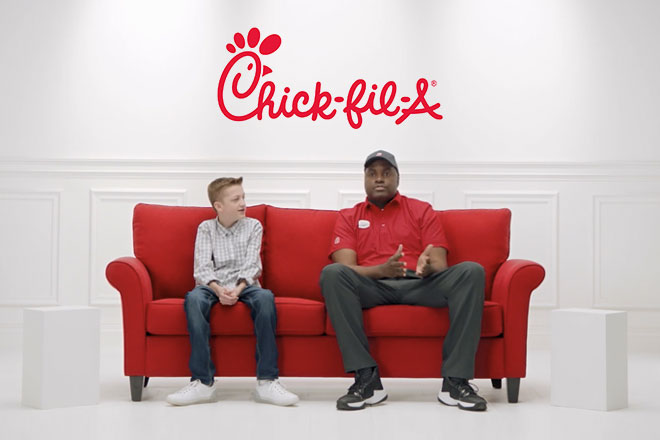
To combat this growing uncertainty of the brand post its 2010s controversies, Chick-fil-A focused all of its efforts into advertising that emphasized its hospitality position by depicting itself as “the inclusive family-first experience,” a message that would have potentially yielded stronger results as a PR effort. The result sadly led to the fall of its ‘Cowscot’ in favor of a more serious campaign focused on re-emphasizing its family-friendly and high-quality food position. While this could certainly be a trend of the times, in the last few years, this pivot from goofy cow appearances to sincere customer interactions does seem to be warming the hearts of critics and complementing the community message it has wanted to reintroduce.
By dropping the one-sided ‘beef’ with beef, the advertising campaign that is still seen today, attempts to leverage similar benefits found in public relations efforts. While the tactic falls under paid media, it hinges on third-party credentials in the form of stories where employees went above and beyond for customers within their local communities. Real-life testimonies included managers assisting in a baby announcement, cashiers holding on to a customer's change for three months, or whole crews working together to sing “Happy Birthday” to a little girl.
Following the same friendly, yet meaningful tone, Chick-fil-A then ran a similar campaign where customers could give their opinion on an item from the menu. While it's up in the air if any of these testimonies are from real people and employees, the commercial spots still speak to a marketing approach hoping to leverage advertising as a means of complementing Chick-fil-A’s PR “strategy” of silently ignoring the effects of its controversies.
Here at Innis Maggiore, we believe that the power of positioning will help keep you relevant in today's world of advertising. In the case of Chick-fil-A, its position as a quality family-friendly restaurant has remained strong in the minds of the public despite the lack of active PR. Had they gone back to basics and formulated a focused PR strategy, rather than banking on pure advertising, the brand could have made a more earnest appeal to its lost customers, and more could’ve been accomplished. However, it is important to recognize that the brand's consistent position served as a safeguard that kept the company from imploding entirely, once again proving the power of positioning.