

The AI marketing landscape is evolving and evolving quickly. In the first few months of this year alone, we’ve seen some major developments. ChatGPT, the place where people actively go for answers, guidance, and recommendations, is getting monetized, allowing brands to appear during moments when people are already highly engaged. As outlined below, things are happening fast, and the brands who win will be the ones who show up genuinely ready to help.
September 2026:
ChatGPT’s Ads Manager has now rolled out to 31 European markets, including Germany, France, and Italy.
A new plugin allows advertisers to build, A/B test, and analyze campaigns directly within ChatGPT or Codex using everyday language. Ready-to-launch ads are built instantly from the notes, websites, or briefs the user submits. Users can easily generate multiple versions of the ads for A/B testing, troubleshoot delivery, track performance, and get prioritized recommendations based on what’s working and what’s not. The plugin also includes a built-in safety feature that previews recommended changes – and requires user confirmation – before applying them across the board.
The update includes several backend enhancements as well. The custom audiences feature now lets users update and modify existing target audiences without having to recreate lists from scratch. For product feed campaigns using the multi-product carousel format, users can track impressions for individual cards in Ads Manager and pull product-level data directly from the public Insights API. Campaigns configured with an overall total budget now utilize an automated pacing mechanism to help spread spend more evenly over time.
We continue to review and implement OpenAI updates, when applicable, to take advantage of platform innovations. We’ve shifted bidding strategies, set max CPC bids, tested ad destinations and headlines, and utilized the updated performance dashboards. We have not been able to test some of the sales or e-commerce-focused capabilities that recently became available.
One of the biggest challenges we continue to experience is the lack of visibility into audience and queries. We are limited in the optimizations we can make compared to other platforms such as Google Ads or Microsoft Ads, which provide real-time insight into queries and user attributes. Despite this lack of insight, we’ve seen improvements in metrics including CTR while maintaining affordable average CPCs and CPMs. This suggests our optimizations are moving us into more relevant conversations cost-effectively.
We look forward to the platform updating and exiting Beta because we feel it will be an essential asset in multi-channel campaigns to maintain visibility across search results as AI continues to grow. As the platform collects data and advances, we expect placements, targeting, ad types, and other elements to become much clearer and more expansive. It will also be interesting to see how attribution is applied in the future, since these ads fall within conversations and not single searches.
In addition, we’ve noticed the average CTR across this platform is lower than other Paid Search platforms like Google Ads or Microsoft Ads, leading us to believe users are using this platform as a discovery tool.
Our organic leads from ChatGPT have been more qualified than our paid leads. This suggests paid efforts have potential, but the platform needs to continue developing.
August 2026:
This month, OpenAI introduced a carousel ad format that allows advertisers to feature several products within a sponsored block. For e-commerce brands, these ads automatically pull live pricing and star ratings from your site’s metadata. In addition, conversion-optimized cost-per-click campaigns are now available in beta for product feeds, and budgets have changed from fixed daily limits to average daily limits, helping distribute spend more evenly. Advertisers can also now exclude specific geographic locations from their campaign targeting to better align delivery with their audience and business needs.
July 2026:
ChatGPT’s Ad Manager continues to evolve, now enabling advertisers to set up custom audiences to include or exclude for their campaigns. Bid multipliers can also be set for audiences at the ad group level. A new overview tab allows users to monitor account health, review recommended tasks that can help improve campaign performance, and analyze key performance metrics in a larger, more flexible trend chart. If a campaign could benefit from broader content coverage to optimize delivery, users may now see the option to select 'Add new ad' in their campaign view. This feature uses existing website metadata to prefill an ad draft with an image, title, and description to review, edit, and assign to a campaign and ad group. It does not, however, generate new copy or imagery with AI. OpenAI has also added new metrics to the control center, including Attributed Sales Value and Sales ROAS. A refreshed static ad card format that’s more compact and easier to read has also been introduced.
June 2026:
ChatGPT has introduced new tools in its Ads Manager Beta to help advertisers manage their campaigns more effectively and improve engagement. Users can now edit campaign budget types, convert CPM campaigns to CPC, set custom CPM max bids, and make bulk campaign edits directly in the Ads Manager interface. In addition, campaigns can now be extended beyond the United States, Canada, Australia, and New Zealand to the United Kingdom, Japan, South Korea, Brazil, and Mexico. ChatGPT has also begun testing multi-advertiser placements on a small subset of ads and offering conversion-optimized campaigns. Product feed ads, which were introduced mid-June, make it easier to incorporate more products in ChatGPT ads, create ads at scale, and connect relevant products with users during high-intent conversations.
May 2026:
According to AdWeek, OpenAI’s privacy policy now openly acknowledges receiving data from advertisers and their partners to measure ad effectiveness on its platform, including data on what users have purchased.
The company has also recently rolled out a beta self-serve Ads Manager that allows advertisers to sign up and purchase ads directly to appear in ChatGPT. Once they’ve registered as advertisers, businesses can add payment information, set budgets, bids and pacing, upload ads, launch and manage campaigns, and view performance in the portal.
Ad buying continues to evolve. In the first phase of the pilot, advertisers could buy ChatGPT ads on a Cost-per-thousand views (CPM) basis. Cost-per-click (CPC) bidding and expanded measurement tools have now been introduced, giving businesses more flexible ways to buy, manage, and understand campaign performance without sharing conversations or personal details with advertisers.
The ChatGPT ad pilot will soon be expanding to the United Kingdom, Mexico, Brazil, Japan, and South Korea, allowing the company to make adjustments as the rollout continues.
April 2026:
OpenAI plans to extend its ad pilot program beyond April, and began asking its more than 600 advertisers in the program for Insertion Order (IO) commitments. This signals a shift from early testing toward a more structured ad business. The company expects to roll out self-serve capabilities this month, while expanding the pilot to Canada, Australia and New Zealand. While 85% of OpenAI’s free and “Go” users in the U.S. are eligible to see ads, less than 20% are shown them on a daily basis. Sam Huston, SVP of Media at DEPT, said the ad-serving process still lacks full transparency and appears to rely on a mix of query intent and advertiser inputs. Early tests point to OpenAI adopting a premium approach, with CPMs hovering around $60.
The question for marketers isn’t whether or not AI will impact their marketing strategy, it’s how their plans will evolve with it. A test-and-learn mindset will be key. We know that people come to ChatGPT with intent. They’re not passively browsing, they’re looking for answers. Brands that show up selling instead of helping will miss the mark, and the genuine opportunity to engage with consumers in an authentic way. ChatGPT ad campaigns that are simple, clear and solution-focused will likely be the ones that gain traction and earn trust.
Previous updates provided below.
March 2026:
ChatGPT began testing an Ads Manager with a small group of partners. According to AdWeek, the Ads Manager dashboard will let marketers run, monitor, and optimize campaigns in real time. An OpenAI spokesperson told the pub that the partner testers will receive weekly Comma Separated Values (CSV) reports (i.e. spreadsheets with performance data like clicks or impressions).
The question for marketers isn’t whether or not AI will impact their marketing strategy; it’s how their plans will evolve with it. A test-and-learn mindset will be key. We know that people come to ChatGPT with intent. They’re not passively browsing; they’re looking for answers. Brands that show up selling instead of helping will miss the mark, and the genuine opportunity to engage with consumers in an authentic way. ChatGPT ad campaigns that are simple, clear, and solution-focused will likely be the ones that gain traction and earn trust.
February 2026:
OpenAI’s top rival, Anthropic, spent millions during the Super Bowl to let people know that, unlike ChatGPT, its Claude chatbot will remain ad-free. “Our users won’t see 'sponsored' links adjacent to their conversations with Claude; nor will Claude’s responses be influenced by advertisers or include third-party product placements our users did not ask for," the company writes in a blog post.
January 2026:
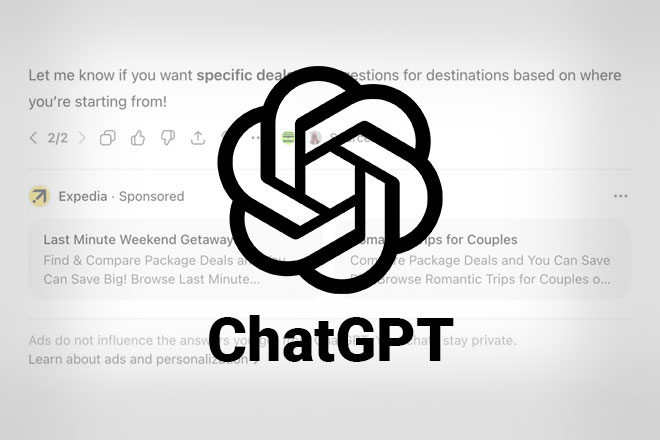
OpenAI announces plans to begin testing ads within ChatGPT. According to the company, the ChatGPT ads will appear as clearly labeled sponsored placements at the bottom of the chatbot’s answers, separate from the assistant’s generated response. OpenAI said it will test ads within its free and “Go” subscription tiers in the U.S., but its Plus, Pro, and Enterprise subscriptions won’t include them. Additionally, users under age 18 won’t see any ads, nor will they appear near certain topics like politics, health, and mental health.
Tune in as we continue to post monthly updates and shed light on this interesting new channel, one that signals an exciting, meaningful shift in how brands and audiences connect.