
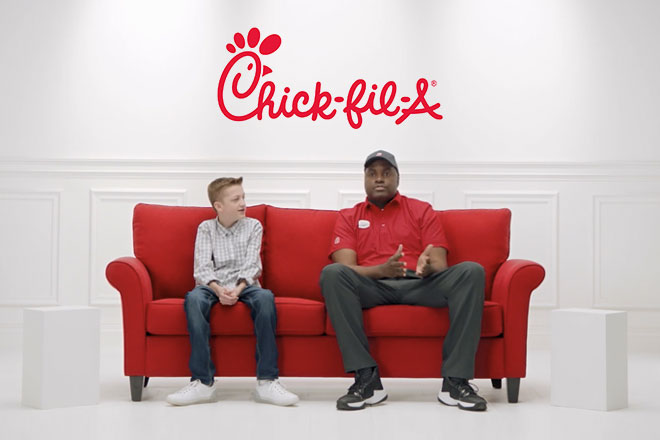
How does a company come back from controversy? Is it pure determination, divine intervention, or something else equally unworldly? It’s the age-old question many brands continue to stumble over, and today, we’re evaluating this conversation through the case of one American fast-food chain: Chick-fil-A.
Over the years, the business has been pulled into controversy, but has remained relevant all the same. From the outside looking in, it might appear as nothing more than pure luck, but I'd argue it’s the die-hard dedication to its position as a high-quality and family-friendly brand that has continued its success despite the turbulence.
Second Mile Service and First Class Food
Since its founding over 70 years ago, Chick-fil-A has been proudly owned and operated by the Cathy family. Devout Christians, their faith has influenced many of the company’s business decisions, namely the franchise’s famous Sunday closures and its biblical service model. In fact, Chick-fil-A’s “Second Mile Service” hospitality standard stems from a biblical verse in Matthew 5:41: “If anyone forces you to go one mile, go with him two.” In the world of Chick-fil-A customer service, the principle implies that if someone requests something from you, it’s your duty to exceed his or her expectations. It challenges employees to go above and beyond for others, staying engaged, proactive, and positive, attributes many customers and even bystanders associate with Chick-fil-A.
Did you know that the recognizable “my pleasure” response is not a mandatory part of a Chick-fil-A worker's training? According to Chick-fil-A’s website, its origin stems from an encounter founder S. Truett Cathy experienced at a higher-end hotel. He said he felt more appreciated because an employee responded with “my pleasure” rather than the typical “you’re welcome” reply. He took that deep feeling of hospitality to heart and wanted to recreate it with every Chick-fil-A customer. After returning home, he asked his Chick-fil-A owners and workers to start responding with “my pleasure,” and now, that phrase has become synonymous with Chick-fil-A’s PR and branding.
The Power of a Strong Position
The company's high standards and work ethic are two reasons Chick-fil-A is known as one of the higher-quality fast-food restaurants worldwide, having held the top spot in the American Customer Satisfaction Index (ACSI) for 11 consecutive years. As a Positionist, I can’t help but appreciate the consistency Chick-fil-A has accomplished in integrating quality service into its company image. But despite that branding, Chick-fil-A hasn’t always resonated with every demographic.
In June of 2012, former CEO Dan Cathy made critical comments toward the LGBTQ community, plunging the company into a public debate. When interviewed by the Biblical Recorder and asked about Chick-fil-A’s indirect support for groups opposing same-sex marriage, Cathy proclaimed he was “guilty as charged,” and that Chick-fil-A is “very much supportive of the biblical definition of the family unit.” His commentary sparked nationwide controversy. GLAAD held protests outside several store locations promoting “same-sex kiss day,” and several mayors, governors, and politicians took to social media to condemn Cathy’s comments, with some taking legislative action to keep Chick-fil-A out of their territories.
Enter a Position-Based PR Response
In an effort to quiet the storm swirling around its stores, Chick-fil-A’s PR team stayed true to its position, posting on Facebook that the company supports all people, no matter their race, religion, creed, gender identity, or sexual orientation, and that going forward, Chick-fil-A would “leave the policy debate over same-sex marriage to the government and political arena.” The company maintained that its biblically based business principles, like closing on Sundays, operating debt-free and devoting a percentage of profits back to local communities, were exactly the things that make them feel like – and operate like – one big family.
And that family-friendly persona continued inside its stores and in its marketing.
While its stores focused on keeping operational standards exceptionally high (remember that “Second Mile Service” standard?), its advertising focused on re-emphasizing its family-friendly and high-quality food position. Real-life testimonies included managers assisting in a baby announcement, cashiers holding on to a customer's change for three months, or whole crews working together to sing “Happy Birthday” to a little girl. It was a calculated, strategic decision to anchor the brand in the product, not the politics.
Several years later, Chick-fil-A came under fire again from LGBTQ activists who claimed that the company was still actively donating to groups like Fellowship of Christian Athletes and Paul Anderson (P.A.) Youth Home, both of which vocally advocate against homosexuality within their programming. As backlash ensued, Chick-fil-A’s PR team doubled down on its position, announcing that it was simply fulfilling its multi-year commitment to those organizations and that commitment had ended in 2018. According to the spokesperson, all of the company’s giving was now focused on education, homelessness, and hunger, a clear nod to its family-first philosophy.
And Chick-fil-A followed its proclamation with action.
In April 2026, the company announced its biggest investment in education to date, awarding more than $29 million in scholarships to Chick-fil-A employees and community leaders across the U.S., Puerto Rico, and Canada. Videos showing Chick-filA’s CEO and other execs personally surprising $25,000 scholarship winners at their local drive-thrus were sent to local news networks, building buzz, interest, and positive press coverage.
Chick-fil-A has also made a concerted effort to make its store operators the face of the brand in local markets, further building goodwill through community-focused PR. Chick-fil-A’s “Shared Table” initiative enables store operators to donate surplus food from their restaurants to local food banks, homeless shelters, and nonprofits. Together, operators have donated more than 42 million meals across the U.S. and Canada, a powerful example of its position in action, and equally powerful headline for the PR team.
And when disaster strikes, Chick-fil-A is often among the first to step in and put its positioning into practice. But instead of deploying standard corporate press releases or multi-million dollar ad campaigns, the PR comes in the form of a fully-branded, 53-foot “Mobile Kitchen.” When this massive semi rolls into areas hit by disaster, people take note. In fact, local residents and news anchors are often seen taking (and sharing!) pictures and videos of the truck, creating immediate social media buzz before sandwiches are ever handed out. And when they are, it’s done by franchise operators, team members, and local volunteers. True marketing in motion, and organic PR at its best.
Over the years, Chick-fil-A’s position as a quality, family-friendly restaurant has remained strong, and its marketing and PR efforts have stayed true to its positioning. Inside its stores, a consistently great product – and experience – have given people a non-political reason to keep coming back. And a PR strategy built around its family-first principles and community commitment has overshadowed any negative news that’s happened around it. In the end, this consistent position has served as a true safeguard for the company, ultimately proving how powerful positioning can be.
PR is said to be one of the most effective brand-building tools, one that allows companies to tell their stories, highlight their values, and help frame public perception. If you’re looking for an agency that has PR chops and also knows how to align your marketing toolbox with your brand positioning, look no further than Innis Maggiore. It would be our pleasure to help.